Apex IT
  • Who We Are
  • Services
  • Expertise
  • Apex Theorem
  • Blog
  • Menu Menu
  • Link to LinkedIn
  • Link to Facebook
  • Link to X
  • Link to Youtube

Will Your CRM Anticipate The Next Big Change, Or Hold You Back?

November 17, 2025/in Uncategorized/by apexit

How do you prepare for all the swirling ecosystem changes for the next couple years and beyond? 

Think of your CRM as having the ability to perform a specific sport, with all the aspects of that sport mastered. But now you must prepare to become good at multiple sports. 

Well, just like getting yourself ready for a triathlon, the first step will begin by measuring where you’re at today.  

Out with the Old
Before you can move forward, you need to clear the deck of technical debt that will slow you down. 

  • Identify end of support and retirement items.
    It’s critical to list all the components that will not have support going forward or have already reached their end of support i.e. Salesforce Workflow Rules, Live Agent chat, etc. 
  • Perform a comprehensive health check.
    Find the aging API versions, enforce your data archive strategy, update installed packages, etc. 
  • Ensure security and privacy compliance.
    Has your metadata architecture kept up with GDPR, CCPA, and other regulations?
    Have you solidified the process for onboarding and offboarding users? 

Are your permissions configured on Profiles, or within Permission Sets in Salesforce? (If you said Profiles, you’ll want to revisit your future strategy). 

  • Data fitness.
    Everyone bangs the drum of having good clean data, to use for future AI grounding. This KPI is only going to continue in importance, and you should already be tracking your current state.  Duplicated, orphaned, and incomplete records will erode trust in all your measurements. 

Two Change Drivers: Scale and AI 

Two forces are converging: business scale and AI capability. Manufacturing firms are consolidating acquisitions into a single CRM. Retailers are unifying online and in-store data. Universities are removing walls between department silos. At the same time, generative AI promises to automate qualification, summarization, and next-best-action recommendations, but only if your org can deliver clean, permissioned data in real time.​ 

Thriving orgs will be those that treat their CRM as a composable platform, not a monolithic application. That means modular architecture, event-driven integration, and strict data governance.  

The orgs that struggle will be the ones pretending it’s still 2018. Along with no test coverage, no change log, and no idea which fields feed downstream systems.  

Architect for Flexibility and Scale 

Future-proofing architecture is going to be a modular, composable approach. With domain areas such as Sales, Service, Finance, etc. These domains should communicate and share but not be tightly coupled and built in such a way that is brittle and easily broken.  

If a new acquisition needs to go live next quarter, can your architecture absorb it without a six-month rewrite? 

An intentional Developer Operations (DevOps) strategy and governance will also prevent integration sprawl and custom code when configuration is possible. If integrations and configurations are invisible to your DevOps pipeline, pieces will certainly break when you least expect it. 

A modern DevOps will have source control for all metadata, and work towards automating more, such as test coverage and even deployments.  


Speed of change  Slow; every change risks breaking unrelated features  Fast; isolated domains deploy independently 
Merge/acquisition  Requires full rewrite or separate org  Plug in new domain via events and APIs 
Testing  Entirely manual, limited; no standard  Automated assistance, modular, comprehensive 
AI deployment  Not scalable; data permissions tangled  Controlled; strict access policies, ROI defined 
Limits  Frequent collisions  Isolated or tracked by domain 
Cost of ownership  High; every change is expensive  Lower; standardized patterns reduce rework 


Use Case Examples 

Manufacturing  Deploy an Agentforce agent to answer warranty and parts availability questions
 Track distributor portal adoption and case deflection rate 
  

Retail 

Integrate online and in-store purchase history into Data Cloud to power personalized email and SMS campaigns
 Deploy a self-service AI agent for order status and returns
 Track repeat purchase rate and net promoter score 
 

Higher Education 

Create an AI agent to answer FAQs (internally and externally) 


Track answer helpfulness and knowledge article usage 


The Fork in the Road 

Your organization faces a choice. Continue patching legacy automation, being reactive to every new release and every business pivot, or invest now in a composable, governed, AI-ready platform that scales with your ambitions. 

The cost of inaction is rising. Every quarter you delay modernizing architecture, data, and DevOps, you accrue technical debt that will block the next acquisition, product launch, or AI deployment.  

The cost of action is manageable if you sequence it correctly: start with quick wins (retire aging features, deploy one AI agent), build momentum with measurable KPIs, and reinvest savings into the next wave. 

The question is not whether your CRM will change. The question is whether you will control that change or be controlled by it. 

By: Corey Doohan 
https://apexit.com/wp-content/uploads/2025/11/SF-Manufacturing.png 200 600 apexit https://apexit.com/wp-content/uploads/2022/02/apexit-white-white2.png apexit2025-11-17 16:13:322025-11-17 16:13:32Will Your CRM Anticipate The Next Big Change, Or Hold You Back?

Flow Custom Error Messages: A Smarter User Experience in Salesforce

September 30, 2025/in Uncategorized/by apexit

A Practical Enhancement from the Apex IT Team

At Apex IT, we’re always looking for ways to simplify and enhance the user experience. One recent improvement focused on a small but critical part of the Salesforce ecosystem: the often-confusing system-generated error messages within Screen Flows.

For any team that relies on Flows to guide users through processes, these cryptic errors can be frustrating and disruptive. But what if your flows could provide helpful, user-friendly guidance instead? That’s exactly what we set out to accomplish — and we’re excited to share how Flow Custom Error Messages are improving clarity, efficiency, and the overall Salesforce experience.


The Problem with Default Flow Errors

It’s a common scenario: a user diligently fills out a screen flow, hits “Next,” and instead of progressing, they’re met with a wall of technical jargon. While these messages are helpful to developers, they often confuse end users, derail their workflows, and increase dependency on support teams.

We knew there had to be a better way. So, we set out to transform these messages from frustrating blockers into clear, actionable prompts.


Our Approach: Decoding and Rewriting Errors in Real Time

Rather than expose the raw system error, we built logic directly into the Flow to intercept and reinterpret the message. By identifying common patterns and keywords within system-generated errors, we leveraged Flow functions — including conditional logic and text manipulation — to parse the error and produce a friendlier version for the user.

The result? A behind-the-scenes system that detects known error types and outputs guidance in plain language. For example:

Original System Error FIELD_INTEGRITY_EXCEPTION: field integrity exception: [Custom_Field__c] (Required fields are missing: [Custom_Field__c])

Custom Error Message “Oops! It looks like the ‘[Field Label of Custom_Field__c]’ field is required. Please make sure to fill it in before continuing.”


Why This Matters: Four Key Benefits

1. Improved Clarity Users no longer have to decipher complex error codes. Instead, they receive messages that clearly explain what went wrong.

2. Actionable Guidance The custom messages often suggest how to resolve the issue — helping users correct input without needing to contact support.

3. Reduced Frustration Clear communication reduces user stress and improves the perception of the system as intuitive and user-friendly.

4. Increased Efficiency Empowered users resolve their own issues faster, keeping workflows moving and reducing reliance on support teams.


What’s Next

This enhancement reflects our ongoing commitment to human-centered design. We believe technology should empower people, not confuse them. Flow Custom Error Messages are just one example of how we’re bridging the gap between technical capability and user experience.

Looking ahead, we’ll continue to find new ways to make Salesforce smarter, more supportive, and better aligned to the needs of its users.

By Jerrad Jacobson

https://apexit.com/wp-content/uploads/2025/09/SF-Manufacturing.png 200 600 apexit https://apexit.com/wp-content/uploads/2022/02/apexit-white-white2.png apexit2025-09-30 16:54:262025-09-30 16:54:26Flow Custom Error Messages: A Smarter User Experience in Salesforce

Certifications, Culture, and Conferences: Investing in Your Salesforce Talent

July 30, 2025/in Custom Development, Salesforce Commerce Cloud, Salesforce Data Cloud, Uncategorized/by apexit

In today’s fast-paced digital landscape, organizations are under constant pressure to innovate, streamline operations, and deliver value to customers more efficiently than ever. For businesses leveraging the Salesforce platform, a common question arises among technology leaders: Do Salesforce certifications actually add value to my team, or are they just resume badges? 


As a Salesforce architect and consultant working with organizations across industries, I’ve seen firsthand how certifications can shape the competence and confidence of delivery teams. While the certification program is not without its limitations, the overall value proposition for organizations is strong—especially when certifications are part of a broader investment in professional development. 

One organization that I worked with recently had a team of very green admins—individuals with little to no prior Salesforce experience—who initially relied heavily on external consultants for even basic configuration and support. As the organization prioritized training and began encouraging the team to pursue Salesforce certifications, we saw a clear shift. Within a few months, the internal team was confidently managing day-to-day operations on their own. External consultants were still involved, but now in a more strategic and advisory capacity. With this boost in internal capability, the organization was able to accelerate innovation, rolling out customer-facing chatbots and automating key service processes with minimal external support. Certifications didn’t just validate knowledge—they helped unlock it. 


The Pros: What Certifications Bring to Your Team 

  1. Proven, Verified Knowledge

Salesforce certifications are a clear validation of a professional’s understanding of specific areas of the platform. Whether it’s an Admin, Platform Developer, or Consultant certification, each credential reflects a standardized baseline of knowledge and best practices. For IT leaders managing increasingly complex ecosystems, this consistency matters. 

When you’re hiring for or building a team, certification provides reassurance that the individual has the foundational knowledge to navigate the Salesforce platform confidently. For partners and vendors, certifications can be a signal of credibility, capability, and commitment to quality. 

  1. Boosting Confidence and Combating Imposter Syndrome

For many professionals—especially those transitioning into new roles or learning on the job—imposter syndrome is real. Earning a Salesforce certification provides validation of their skills, helping team members feel more confident and credible in their roles. This confidence translates into better communication, stronger collaboration, and more decisive problem-solving on projects. 

  1. Alignment with Industry Best Practices

Salesforce certifications are designed around widely accepted best practices, which helps ensure your team isn’t reinventing the wheel with each implementation. Certified professionals are trained to follow proven approaches to configuration, development, and governance. This creates a consistent process framework across your delivery team—whether internal staff or external partners—reducing variability and improving the speed and quality of project execution. 

  1. Morale and Retention

Investing in employee certifications sends a powerful message: “We value your growth.” For many employees, this is more than a checkbox—it’s a motivator. Certified team members often feel more empowered and engaged in their roles. And engagement correlates strongly with retention, which is especially critical in a competitive talent market. 


The Cons: What Certifications Don’t Guarantee 

While Salesforce certifications are valuable, they are not a guarantee of success. 

  1. Experience Still Matters

Certification exams test knowledge and sometimes a person’s test-taking ability, not judgment. A newly certified Admin might know all the right terms but still struggle with the real-world application of those skills in a live environment. That’s why certifications are most powerful when paired with hands-on experience. They open the door but don’t walk you through it. 

  1. Cost and Time Commitment

 Preparation for certification exams takes time, and the exams themselves have a price tag. While these are usually modest compared to the potential ROI, it’s still a consideration—especially when budgeting for training across an entire team. 


Certifications as a Gateway to Broader Professional Development 

Perhaps the greatest value of the certification journey is that it often becomes the catalyst for a broader culture of learning and professional development. Certifications can serve as the starting point—but they shouldn’t be the endpoint. 

To keep your Salesforce team future-ready, it’s critical to pair certifications with ongoing development opportunities such as mentorship programs, cross-training, and hands-on project rotations. One of the most underrated aspects of professional development? Participation in networking events and industry conferences. 


Conferences: Not Just for Lead Generation 

Many organizations think of conferences as marketing opportunities or sales events. And while those are valid goals, the true value of conference attendance for technical teams is deeper and longer-lasting. 

At Salesforce events like Dreamforce, TrailblazerDX, or community-led gatherings like Dreamin’ events, your team members are exposed to emerging trends, real-world success stories, innovative demos, and live solution architectures from some of the brightest minds in the ecosystem. They return inspired, informed, and better equipped to bring those insights back to your organization. 

Moreover, conferences are breeding grounds for peer learning. Your team can make connections with others facing the same challenges, accelerating problem-solving and collaboration. This kind of networking can lead to better vendor choices, smarter implementations, and quicker issue resolution down the line. 

One of the most persistent fears among leaders is that investing in certifications and conference attendance will make team members more likely to leave for better opportunities. But the reality is just the opposite: employees are more likely to leave when they feel stagnant, undervalued, or disconnected from professional growth. Supporting your team’s development builds loyalty, increases engagement, and fosters a culture where people want to stay and grow. In today’s talent market, the real risk isn’t training people and losing them—it’s not training them and keeping them. 


A Strategic Investment 

For Salesforce leaders in any industry, the takeaway is this: Salesforce certifications, when approached strategically, deliver real value. They ensure a baseline of technical knowledge, reduce onboarding risk, and encourage employee engagement. But they’re only one piece of a larger puzzle. The organizations that get the most out of their Salesforce investment are the ones that see certification not as a checkbox, but as the beginning of a broader professional development journey.  

Invest in your team.  

Send them to conferences.  

Encourage peer engagement.  

The return isn’t just technical—it’s cultural, strategic, and long-term. 


By: Jillian Proia


*Did you find this article helpful? Share it with your network and help other leaders improve their systems.* 

https://apexit.com/wp-content/uploads/2025/07/SF-Manufacturing-9.jpg 200 600 apexit https://apexit.com/wp-content/uploads/2022/02/apexit-white-white2.png apexit2025-07-30 16:26:552025-07-30 16:31:45Certifications, Culture, and Conferences: Investing in Your Salesforce Talent

Single Org or Multi-Org: What’s Right for Your Nonprofit’s Salesforce Journey?

June 24, 2025/in Salesforce, Uncategorized/by apexit

In the nonprofit world, every dollar counts—and so does every hour. Choosing the right Salesforce architecture isn’t just a technical decision. It directly impacts how efficiently your team operates, how securely your data is managed, and how ready your organization is for growth. 


What Is Salesforce Nonprofit Cloud? 

More than just a CRM, Salesforce Nonprofit Cloud is a suite of purpose-built tools that help mission-driven organizations manage fundraising, programs, volunteers, and outcomes—all in one place. 

The latest Nonprofit Cloud on Core (NPC on Core) model takes things a step further, reimagining how nonprofit data is structured and connected. With features like Program Management, Outcome Management, and Constituent Journeys, organizations gain a clearer, more unified view of their impact. 

But with great flexibility comes an important question I often hear as a Solution Architect: 

“Should we use a single org or multiple orgs for our nonprofit programs?”

Let’s explore that.  

Understanding Org Strategies: Single vs. multi-org 

Single Org: All teams, counties, or affiliates operate within the same Salesforce instance. Data is separated logically using role hierarchies, record types, and sharing rules. 

Multi-Org: Each team or affiliate has its own dedicated Salesforce org. These can be integrated into varying degrees based on business needs. Requires specialized skill sets to manage development and deployment processes, including proficiency with scratch orgs, VS Code, and CI/CD automation. Aggregated reporting requires an external BI tool, CRM Analytics, or Data Cloud. 


When a Single Org Makes Sense 

  • Centralized Governance – One admin team manages all changes. 
  • Shared Data Models – Standardized programs and outcomes. 
  • Consistent UX – Unified processes, easier training. 
  • Consolidated Reporting – Seamless roll-up across programs or regions. 

Use Case: A nonprofit with regional programs using the same framework and reporting standards. 

When a Multi-Org Approach Wins 

  • Autonomy – Flexibility for either centralized development & governance or local teams to control branding, processes, and data 
  • Diverse Funding Models – Tailored goals and metrics per org. 
  • Different Lifecycles – Some chapters piloting Salesforce, others fully adopted. 
  • Data Sensitivity – Complex, sensitive data model with many independent units enforcing strict data segregation. 

Use Case: A national nonprofit with state-level chapters operating like independent mini-organizations. 

 Choosing the Right Salesforce Org Strategy 

Nonprofits often operate with affiliates, chapters, or regional offices with unique needs. The right strategy depends on following major factors: 

  • How standardized are your processes across teams.

A single org is a better fit when most teams follow a unified business process. If each affiliate operates independently with entirely different workflows, a multi-org setup may be more manageable. 

  • Sharing Model Complexity in Single Org:

When regional offices or chapters require strict data access boundaries, a single org may run into scalability issues with Organization-Wide Defaults (OWDs) and Sharing Rules. For example, Salesforce imposes a limit of 300 sharing rules per object, which can be quickly exceeded when fine-grained access is needed across counties, programs, or roles. In such cases, Apex-managed sharing becomes necessary, increasing development and maintenance overhead. 

  • Simplified Security in Multi-Org:

In a multi-org setup, each affiliate or region operates in its own Salesforce environment, which naturally isolates users and data. This eliminates the need for complex sharing rules and simplifies compliance, especially when dealing with localized data governance policies. 

  • Customization Conflicts in Single Org:

A shared environment can lead to configuration contention, where teams with different needs compete for object model design, automation, and page layouts. Without strong governance, this can cause friction and reduce agility. A multi-org structure avoids this by allowing each org to tailor its environment independently. 

  • Unified Reporting Requires BI Tools in Multi-Org:

One of the biggest trade-offs with a multi-org strategy is reporting. Since data resides in separate orgs, consolidated reports across all affiliates aren’t natively possible in Salesforce. Organizations typically need to rely on Business Intelligence (BI) tools like Tableau, Power BI, or CRM Analytics, pulling data from each org into a central warehouse for unified dashboards. 

  • 360° Unified View and Constituent Duplication in Multi-Org:

In a multi-org setup—or even within a single org using Nonprofit Cloud—constituents can easily be duplicated across programs, departments, or affiliates, especially if integrations or manual entry create fragmented records. This fragmentation makes it difficult to achieve a 360-degree unified view of a constituent’s interactions, donations, and engagement history. To address this, organizations can turn to Salesforce Data Cloud or an MDM solution, which enables identity resolution and profile unification across disparate sources, helping to build a trusted, single view of everyone. 

Choosing the Right Operating Model 

I frequently draw on the operating models developed by the MIT Sloan Center for Information Systems Research (2005) and later featured in the seminal book ‘Enterprise Architecture as Strategy by Ross, Weill, and Robertson’.  

When you map out how much your teams share data (integration) and how consistent your processes are (standardization), four operating models emerge- 

  • Diversification (Low Integration, Low Standardization): 

 This model typically involves multiple Salesforce instances, with departments or divisions managing their own systems independently. Data remains siloed, and IT governance is decentralized, allowing units to operate with greater autonomy but less centralized oversight. 

  • Unification (High Integration, High Standardization): 

Enterprise-wide process control through a single, integrated platform that supports all business functions. Operations are streamlined and managed within a unified Salesforce org, enabling consistency and centralized oversight across all departments. 

  • Coordination (High Integration, Low Standardization): 

Promotes interdepartmental collaboration and enabling decentralized process control, the system relies on middleware and APIs to ensure seamless connectivity across platforms 

  • Replication (Low Integration, High Standardization): 

A harmonized methodology using consistent processes and templates, along with duplicated configurations and segregated data, facilitates scalable and controlled operations across different units. 

DevOps in Single vs. Multi-Org Nonprofit Architectures 

A key architectural consideration for nonprofits adopting Salesforce is how development and deployment workflows (DevOps) scale within Single Org versus Multi-Org environments. The diagram below illustrates two distinct DevOps models—Org-Based Development and Package-Based Development, each aligned with a specific architectural approach. 


In a Single Org model, nonprofits typically follow an Org-Based Development strategy. Developers build and test features directly in sandboxes (e.g., Dev Pro, Partial, Full) using metadata deploy/retrieve methods. This model works well for smaller teams or centralized organizations where all programs and business units operate within the same Salesforce org. Code and configuration changes move up the environment chain—from development to QA to production—using change sets or deployment tools, with all changes managed in a shared version control repository. 

Conversely, a multi-org model—often used by federated nonprofits, university extensions, or national organizations with semi-autonomous affiliates—benefits from a Package-Based Development approach. This model embraces unlocked packages and scratch orgs to modularize features and deploy them consistently across many orgs. Development occurs in isolated scratch orgs per feature or epic, and once tested, package versions are installed in sandboxes and ultimately in production environments, per business unit. This approach enables controlled, scalable, and repeatable deployments—crucial for maintaining consistency across dozens of independently operating orgs. 

For nonprofits, choosing the right DevOps strategy is as much about organizational structure as it is about technical tooling. Single Org models prioritize simplicity and shared data, while multi-org strategies offer flexibility, modularization, and local autonomy—especially when paired with a mature packaging and release process. 


Final Thoughts 

There’s no one-size-fits-all answer—just the right fit for your mission, structure, and strategy. Ask yourself: 

  1. Who owns the data and processes? 
  1. Where do you see this scaling in 3–5 years? 
  1. What regulatory, compliance, or security obligations must be addressed? 
  1. Who is responsible for evolving and maintaining your Salesforce org(s)? 
  1. Have you reached the limits of what you can do in a single org? 


Salesforce Nonprofit Cloud offers incredible flexibility—but the architecture is what determines sustainability and adoption. 

*Did you find this article helpful? Share it with your network and help other leaders improve their systems. * 


By: Ishita Sharma 


📘 Source: Ross, J. W., Weill, P., & Robertson, D. C. (2006). Enterprise Architecture as Strategy 

📘 Source: MIT Sloan Center for Information Systems Research (2005) 

https://apexit.com/wp-content/uploads/2025/06/SF-Manufacturing-6.jpg 200 600 apexit https://apexit.com/wp-content/uploads/2022/02/apexit-white-white2.png apexit2025-06-24 16:14:042025-06-24 16:14:04Single Org or Multi-Org: What’s Right for Your Nonprofit’s Salesforce Journey?

Struggling with GDPR/CCPA in Salesforce? Here’s What You’re Missing

June 2, 2025/in GDPR/ CCPA Salesforce, Salesforce Commerce Cloud, Salesforce Data Cloud, Uncategorized/by apexit

Data is flowing, deals are closing, constituents are engaged. Awesome. But lurking beneath that shiny surface, is your handling of personal data truly compliant with GDPR, CCPA, and the ever-expanding global privacy rulebook? Or is it a hidden liability time bomb, ticking away? 

Who Should Care? (Spoiler: You.) 

Can you instantly find every scrap of John Doe’s data if he asks? Can you prove valid consent for that marketing campaign? Would you have a sinking feeling when a “Right to be Forgotten” request hits your inbox on a Friday afternoon? If there’s any hesitation, you’re likely exposed. 

What’s worse than massive fines? The erosion of trust with your customers or constituents. That damage can last far longer than any penalty. Many think they’re safe. They’ve got a policy page, maybe they did some training. But inside Salesforce – where the data actually lives – the reality is often dangerously different.  

The Compliance Quicksand: Where Orgs Get Stuck 

Salesforce centralizes data – a huge benefit, but also a massive compliance amplifier if not managed proactively. We see the same pitfalls repeatedly. 

Personal data isn’t neatly confined. It sprawls: 

  • Across standard and custom objects/fields. 
  • Potentially buried in Activities, Notes, Attachments. 
  • Flowing through integrated apps (think Marketing, Service, Finance). 
  • Residing in related clouds (Marketing Cloud, Pardot, etc). 
  • Maybe even replicating into Sandboxes. 

If you can’t find it all, reliably and fast, you simply cannot manage or delete it compliantly. 

Consent Theater: Looks Real, Isn’t Compliant 

That single “Opt-in” checkbox from 2021? It’s probably useless under GDPR/CCPA’s demand for granular, informed, specific, and easily revocable consent. 

Still only using one custom checkbox for ‘Consent’? That’s a red flag.  

Modern compliance often needs dedicated custom objects, custom metadata, or an enhanced preference center to track what someone agreed to and when, creating an auditable trail within Salesforce. 

It is imperative that individuals can easily see and change their preferences. Weak consent management isn’t just sloppy; it’s a direct violation waiting for scrutiny. 

DSR Dread: The All-Hands Fire Drill 

A Data Subject Request lands. Panic often follows: 

  • Teams burn precious hours (or days!) manually digging. 
  • The risk of missing critical data (leading to fines) or deleting something essential (breaking processes) is huge. Think Cases, Contacts, or Custom Objects. 
  • It’s wildly inefficient and breeds anxiety. 

The Problem: Manual DSRs are unsustainable, error-prone, and signal a lack of control over your data. 

Accidental Data Hoarding: “Just in Case” Bites Back

Privacy regs mandate data minimization. Keep only what you need, for only as long as you need it. 

  • Are you retaining detailed personal information for years longer than legally required or practically necessary? 
  • Do you have automated retention and secure archiving policies enforced in Salesforce? 

Why Gamble When You Can Partner Smart? Our Edge. 

Fixing this isn’t just about tech; it’s about smart strategy, robust process, and deep expertise.  

Managing complex, overlapping relationships (applicant, student, alum, donor, faculty) within platforms like Education Cloud (EDA) can be easy with the right foundation.  

It’s important to go beyond applying generic business privacy solutions, which often misses critical nuances, creating compliance gaps. 

Here’s why savvy organizations partner with us: 

  • We Blend Expertise: Our teams aren’t just Salesforce gurus. We combine deep technical architects with consultants who understand compliance regulations and operational process improvement. We speak both languages fluently. 
  • Focus on Sustainable Compliance: We don’t just apply band-aids. We help you build repeatable, automated, and auditable processes within Salesforce. 
  • Proven Methods: We’ve tackled these challenges before. We leverage pre-built components and proven methodologies. Getting you compliant faster and more reliably than starting from scratch. 

Key Takeaways: 

  • Proactive Action Beats Reactive Panic: Address compliance before an incident forces your hand. Expert guidance drastically cuts risk and effort. 
  • Identify and Control: Know where all your personable identifying information lives and moves. 
  • Consent is Active & Specific: Implement granular, auditable preference management. 
  • Manual Work = Risky and Slow: Automate your processes. 


Ready to move from anxiety to action? Let’s have a real conversation about your Salesforce instance and specific privacy challenges. 

Choose Your Next Step: 

  • Book a No-Obligation Risk Assessment Call 
  • See how other companies & organizations are streamlining their processes by joining our next webinar 


**Sources:
Salesforce Compliance Certifications – https://compliance.salesforce.com/en 

Salesforce ISO certificates – https://compliance.salesforce.com/en/services/government-cloud-plus 

Interoperability attestation (Working with other systems) – https://help.salesforce.com/s/articleView?id=000384503&type=1 

Salesforce Shield Brochure- https://www.salesforcepublicsectordemos.com/tours/shield 

Salesforce Data Processing Addendum (DPA) – https://www.salesforce.com/content/dam/web/en_us/www/documents/legal/Agreements/data-processing-addendum.pdf 


Written by: Corey Doohan


**Did you find this article helpful? Share it with your network and help other leaders improve their systems.** 

https://apexit.com/wp-content/uploads/2025/06/SF-Manufacturing-3.jpg 200 600 apexit https://apexit.com/wp-content/uploads/2022/02/apexit-white-white2.png apexit2025-06-02 12:22:122025-06-09 15:20:59Struggling with GDPR/CCPA in Salesforce? Here’s What You’re Missing

Expanding Horizons: How Cultural Intelligence Drives Apex IT’s Latin America Expansion

February 14, 2025/in Uncategorized/by apexit

At  Apex IT, we’ve always believed that technology thrives when supported by global talent and local expertise. As leaders in Oracle and Salesforce solutions, we empower businesses across the US by blending innovation with a deep understanding of our clients’ needs. Today, we’re taking a strategic step forward by expanding our operations into Latin America (beginning with Colombia), strengthening our global team, and enhancing service delivery for our clients globally.

But this isn’t just about technology or entering a new market—it’s about people, partnerships, and the power of cultural understanding. Our vision is to build a world-class team that elevates our capabilities, and to do this successfully, we’re embracing cultural intelligence every step of the way.


Why Culture is the Key to Success in Latin America 

To unite teams across borders, cultural understanding isn’t optional—it’s essential. Latin America is a tapestry of diverse traditions, values, and business practices. To deliver transformative solutions here, we must first listen, learn, and adapt. Here’s why cultural intelligence matters:

  1. Relationships Over Transactions
    In Colombia—and across Latin America—trust isn’t built through contracts alone. It’s forged over cafecitos (coffee breaks), shared stories, and genuine connections. At Apex IT, we’re investing time to understand the vibrant market, unique challenges and cultural contexts. Because the strongest systems are built on stronger relationships.
  2. Respect for Local Nuances
    From the bustling tech hubs of Bogotá to the entrepreneurial spirit of Medellín, Colombian businesses prioritize flexibility, warmth, and long-term collaboration. We’re tailoring our approach to honor these values, ensuring our approach align with local rhythms rather than imposing foreign frameworks.
  3. Global Expertise, Local Insights
    With teams in the US, India, and now Colombia, we’re bridging continents to create a truly global yet locally attuned workforce. Diversity isn’t just a buzzword—it’s the lens through which we innovate.

Lessons from India: A Blueprint for Latin America 

Our successful expansion into India taught us a vital lesson: cultural agility is the cornerstone of growth. Just as we adapted to India’s dynamic tech ecosystem, we’re applying those insights to Latin America:

  • Hiring Local Talent: We’re building a Colombian team that blends regional expertise with Apex IT’s global technical prowess.
  • Cultural Training: Equipping global teams with insights into Colombian work culture, communication styles, and the art of “tomar un café” (sharing coffee) to strengthen rapport.
  • Partnering with Experts: Collaborating with local advisors to navigate regulations, customs, and market dynamics.
  • Bilingual Collaboration: Encouraging Spanish-English fluency to ensure clarity and inclusivity across teams.

The Apex IT Difference: A Global Team with a Local Heart 

Our Colombian team isn’t just an extension of our US operations—it’s a strategic asset. Here’s how we’re integrating them:

  • Real-Time Collaboration: Leveraging Colombia’s time zone overlap with the US to accelerate project delivery and client responsiveness.
  • Empowering Local Leadership: Giving Colombian talent ownership of projects and decision-making roles, ensuring their expertise shapes outcomes.
  • Investing in Growth: Sponsoring certifications (e.g., Salesforce, Oracle Cloud) and leadership programs to nurture long-term careers.

Looking Ahead: A Stronger Global Footprint 

Colombia is just the beginning. As we deepen our roots here, we’re laying the groundwork to expand our footprints across Mexico, Brazil, Argentina, and beyond. Our goal? To become the region’s most trusted partner for Oracle and Salesforce solutions—not by replicating what works elsewhere, but by co-creating value with Latin America’s innovators.

Final Thoughts 

Expanding into Latin America isn’t about geography—it’s about people, potential, and partnership. At Apex IT, we’re not just implementing technology; we’re building bridges between cultures, technologies, and possibilities.


Abhas Srivastava
Vice President – Latin America
Apex IT
Global Vision, Local Heart 💙
US | India | Colombia


https://apexit.com/wp-content/uploads/2025/02/Screenshot-2025-02-14-at-11.58.35 AM.png 273 620 apexit https://apexit.com/wp-content/uploads/2022/02/apexit-white-white2.png apexit2025-02-14 18:00:162025-02-17 19:22:18Expanding Horizons: How Cultural Intelligence Drives Apex IT’s Latin America Expansion

Transform Your Marketing and E-Commerce with Emarsys and Salesforce Commerce Cloud

October 16, 2024/in Salesforce Commerce Cloud, Uncategorized/by apexit
Struggling to engage customers and boost sales? You’re not alone. At Apex IT, we’ve been helping businesses just like yours overcome these challenges with the power of Emarsys B2C Marketing and Salesforce Commerce Cloud. Read on to discover common pain points and the solutions we’ve found that drive real results.

Fragmented Customer Journeys

Problem: Customers receive inconsistent messages across different channels.
Solution: Emarsys creates personalized, omni-channel experiences, ensuring your messaging is always relevant and cohesive.

Time-Consuming Campaign Management

Problem: Creating and managing campaigns takes too much time and resources.
Solution: Emarsys offers easy-to-use automation tools, allowing you to focus on strategy while it handles the execution.

Lack of Customer Insights

Problem: Making data-driven decisions is challenging without clear insights.
Solution: Emarsys provides predictive analytics to anticipate customer behavior and optimize campaigns.

Scaling E-Commerce Operations

Problem: Your current platform can’t handle growth or customization needs.
Solution: Salesforce Commerce Cloud scales effortlessly and offers flexible customization to grow with your business.

Global Expansion Challenges

Problem: Reaching and serving a global audience is complex.
Solution: Salesforce Commerce Cloud supports multiple languages, currencies, and payment methods, making global expansion seamless.

Disconnected E-Commerce and Marketing Efforts

Problem: Disjointed systems hinder unified customer engagement.
Solution: Integrating Emarsys with Salesforce Commerce Cloud provides a powerful, unified platform for personalized marketing and efficient e-commerce operations.

Empower your business to overcome these challenges and achieve new heights with Emarsys B2C Marketing and Salesforce Commerce Cloud. Reach out to us to explore how these platforms work together to deliver a unified marketing and e-commerce solution.
And if you have any questions, don’t hesitate to get in touch with Austin Maxey.

Austin Maxey
VP-Salesforce
austin.maxey@apexit.com
Apex IT
https://apexit.com/wp-content/uploads/2024/10/marketing-challenges-and-how-to-overcome-them-new-hero.jpeg 521 1800 apexit https://apexit.com/wp-content/uploads/2022/02/apexit-white-white2.png apexit2024-10-16 18:21:322024-10-16 18:21:32Transform Your Marketing and E-Commerce with Emarsys and Salesforce Commerce Cloud

Diversity, Equity, and Inclusion

June 12, 2024/in Uncategorized/by apexit

In today’s rapidly evolving global marketplace, Diversity, Equity, and Inclusion (DEI) are not just buzzwords; they are critical pillars of sustainable success and growth. As a company committed to fostering a culture of inclusivity, we believe that thought leadership in DEI is essential for driving innovation, employee engagement, and community impact. This blog post explores our journey, strategies, and vision for DEI-focused thought leadership, showcasing our dedication to creating a more equitable and inclusive world.

The Importance of DEI

Diversity brings a wealth of perspectives, experiences, and ideas that fuel creativity and innovation. Equity ensures that all employees have access to the same opportunities and resources, enabling them to thrive. Inclusion fosters a sense of belonging, where every individual feels valued and respected. Together, these elements form the foundation of a vibrant, dynamic workplace that can adapt and excel in an increasingly complex and diverse world.

Our DEI Journey

Our commitment to DEI began with a simple yet profound realization: diversity is a strength, and inclusivity is a choice. We embarked on this journey by first assessing our current state, identifying areas for improvement, and setting clear, measurable goals. This involved engaging with employees at all levels, listening to their experiences, and understanding the unique challenges faced by underrepresented groups.

Strategies for DEI Thought Leadership

  1. Leadership Commitment: DEI initiatives must be championed from the top. Our leadership team is dedicated to embedding DEI principles into every aspect of our business, from recruitment and retention to product development and marketing. This commitment is reflected in our company policies, practices, and values.
  2. Inclusive Hiring Practices: We have overhauled our recruitment process to eliminate biases and attract diverse talent. This includes implementing blind recruitment techniques, expanding our talent pool to underrepresented communities, and providing bias training for hiring managers.
  3. Continuous Education and Training: DEI is an ongoing learning journey. We offer regular training sessions on unconscious bias, cultural competency, and inclusive leadership. These programs are designed to empower employees with the knowledge and skills to foster an inclusive workplace.
  4. Employee Resource Groups (ERGs): Our ERGs play a crucial role in promoting diversity and inclusion. These groups provide a platform for employees to connect, share experiences, and advocate for change. They also help us identify and address specific needs within our diverse workforce.
  5. Community Engagement: We believe in giving back to the communities we serve. Our DEI initiatives extend beyond the workplace, encompassing community outreach, partnerships with diverse organizations, and support for social justice causes.

Impact and Future Vision

Our DEI initiatives have already yielded significant results. We have seen increased employee engagement, higher retention rates, and a more innovative and collaborative work environment. Our commitment to DEI has also enhanced our brand reputation, attracting customers and partners who share our values.

Looking ahead, we aim to deepen our DEI impact by continuing to push boundaries and challenge the status quo. We plan to expand our DEI training programs, increase support for ERGs, and enhance our community engagement efforts. Additionally, we will leverage data and technology to drive more informed decision-making and track our progress more effectively.

Embracing DEI is not just the right thing to do; it is a strategic imperative that drives business success. As thought leaders in DEI, we are committed to fostering a culture of diversity, equity, and inclusion that empowers our employees, benefits our customers, and positively impacts society. We invite you to join us on this journey towards a more equitable and inclusive future.

By prioritizing DEI, we are not only building a better company but also contributing to a better world. Together, we can make a difference.

https://apexit.com/wp-content/uploads/2024/06/diversity.png 720 1201 apexit https://apexit.com/wp-content/uploads/2022/02/apexit-white-white2.png apexit2024-06-12 15:48:282024-06-12 15:48:28Diversity, Equity, and Inclusion

Empowering Communities: Apex IT’s Home Weatherization Initiative

February 6, 2024/in Uncategorized/by apexit

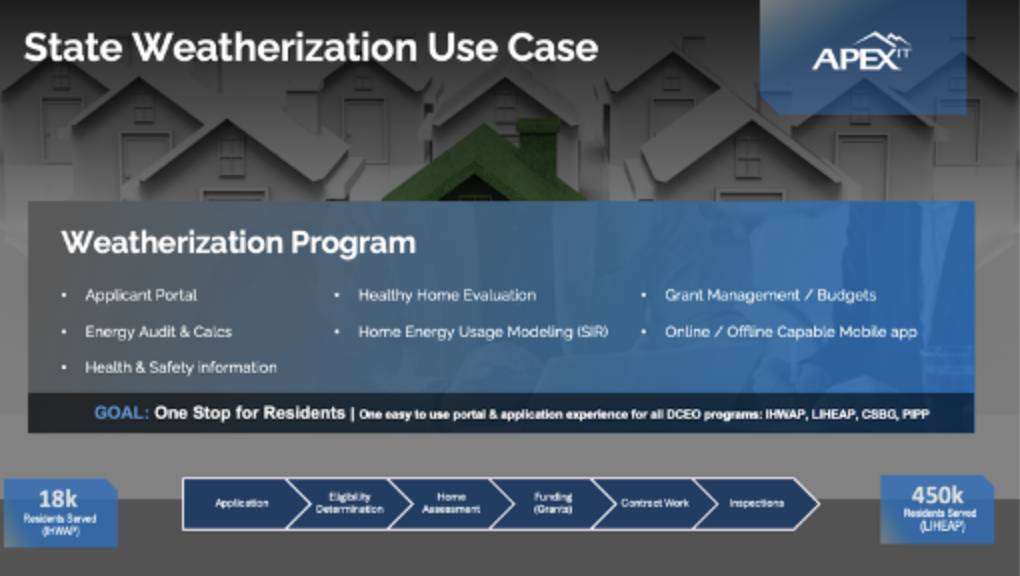
At Apex IT, we’ve played a pivotal role in revolutionizing state departments through our Weatherization Program. Our program boasts a distinctive and user-friendly online portal, integrating eligibility rules, approval workflows, budget management, a tailored mobile application for assessors, and more.


We’re at the forefront of modernizing the Home Weatherization Program, dedicated to enhancing energy efficiency and weather resilience in homes. This initiative brings numerous benefits to low-income residents.

Key Benefits of Weatherization for Social Service Programs:

  • Energy cost savings
  • Improved comfort
  • Health and safety enhancements
  • Reduced environmental impact
  • Job creation
  • Community resilience
  • Government savings
  • Long-term financial stability


Explore a real-life case with one local government- a testament to our commitment to transformative solutions.


Features Include: 

  • Easy-to-use online portal for residents
  • Built-in eligibility rules
  • Approval workflows
  • Budget management
  • Custom mobile application for assessors
  • File attachments service
  • Rules engines for enforcing business rules
  • Quality assurance monitoring survey tool
  • Integrations with utility providers and state systems
  • Accessibility features
  • OKTA integration for single sign-on

By addressing energy poverty, improving living conditions, and contributing to the overall well-being and resilience of communities, Apex IT’s initiative is making a significant impact. We believe that this program’s success will not only lead to financial savings for residents but also create a more sustainable and resilient future.

Learn more about the Home Weatherization Program and how we can help your organization with positive change.

Contact Keegan Olson (keegan.olso@apexit.com)


https://apexit.com/wp-content/uploads/2024/02/image-6.png 887 1159 apexit https://apexit.com/wp-content/uploads/2022/02/apexit-white-white2.png apexit2024-02-06 15:49:112024-02-06 15:49:11Empowering Communities: Apex IT’s Home Weatherization Initiative
  • Customer Experience
  • Marketing
  • MDM
  • News
  • Philanthropy

Who We Are
Services
Expertise
Theorem

 
Blog
Careers
Contact Us

 
FOLLOW US


Mailing Address
400 S 4th St
Suite 401 PMB 120
Minneapolis, MN 55415
+1 651-287-9342

© 2022 Apex IT Copyright   |   Privacy Policy
Scroll to top Scroll to top Scroll to top